For B2B marketing teams
Measure, evaluate, and influence your AI visibility.If you want to resonate with buyers, listen to them.
Buyers ask ChatGPT, Claude, Gemini, and Perplexity what to buy. We help brands measure, evaluate, and influence how they show up in those answers. It starts with a free map of who buys from you and what they weigh, and it gets sharper when we read your own sales calls against it. Enter your site below to start.
Enter the website to map, like yourcompany.com. Your Foundation is built from it.
What's a Foundation? → · Prefer email? Sign up instead.
Every tool in this category scores you against questions it guessed.
A visibility score is only as good as the questions behind it. Put a set of questions to four engines and you get a number, and that number describes the questions rather than your market. So the whole discipline rests on a step almost nobody examines: where did the questions come from?
They came from the public web. The category's tools read what has been published about an industry, infer how buyers in it probably talk, and generate prompts from that inference. It is synthetic by construction. Some of it is good, and none of it is a record of anything a buyer said.
What public evidence finds
Named vendors, their positioning, their published comparisons, and the capabilities the category talks about in public. It is very good at finding companies.
What only your calls hold
The words your buyers use for the problem before anyone renames it. The objections nobody on your site has answered. The moment a purchase actually starts. The option they weighed that no vendor list contains.
If you are not influencing the questions the engines are answering, you do not show up. The questions are the product.
How it works
Map it for free. Then listen before you measure.
Your Foundation is the agreement everything runs on. It is built from public evidence, which makes it a well-researched guess about your buyers. The rest of the work exists to turn that guess into a record.
1 · Your Foundation and your questions Free
We read your site and your category and build the map: who buys from you, who you are measured against, the capabilities they weigh, the pains they carry, and what a crawler can actually read. You correct it. We write your 150 buyer questions from the map you approved. Both are yours whether or not we ever speak again.
2 · Your calls, run against the map In the $997
Your recorded sales calls are a record. We read them against the map and build your Voice of Customer: what your buyers actually said, in their own words, with the speaker role, call, and date on every line. What they confirmed gets weight. What they objected to gets a question. What the map never had gets added.
3 · The crawl, on the questions your calls produced In the $997
The map changes, so the questions change. Rows your buyers confirmed get more of the 150. Every objection they raised gets its own. Four engines, every answer validated by a person, and the report with a ranked action plan in your account within 72 hours of the questions locking.
Voice of Customer
Your buyers already told you what they weigh.
It is sitting in your sales calls. We read them against your Foundation and build your Voice of Customer: the record of what your buyers actually said, in their own words, with the call and the date attached to every line.
Their words
The phrases your buyers use for the problem, before your marketing renames it.
Those are the words the engines get asked.
Their objections
What they pushed back on, and what nothing on your site answers yet.
Each one becomes a question we measure and a page you have not written.
Their insights
The moment a purchase actually starts, and what changed to start it.
The map guesses this. The calls know.
Their competitive matching
Who they were really weighing you against.
Including the options no vendor list contains.
Then the map changes, so the questions change. That is what makes the crawl worth running: it measures the questions your buyers are actually asking, and the plan that comes back answers objections you can cite by call and date.
What one Visibility Crawl series produced
Getting the questions right is the setup. This is the payoff, measured on a fixed set: Insynctive, a B2B HRIS platform, went from effectively invisible in AI to 12x more visible in six weeks, on a matched 150-query set across ChatGPT, Claude, Gemini, and Perplexity.
Insynctive
12x
More visible by week six
Buyer queries surfacing Insynctive went from 2 to 24 of 150, on the same matched set.
6x
At the four-week re-crawl
Already 6 times more visible at the formal re-crawl: 12 of 150 queries.
38
Pages shipped
Net-new server-rendered GEO pages in the first four weeks.
+504%
ChatGPT bot traffic
GPTBot crawl volume rose about 6x over baseline once the site became readable.
Crawler traffic moves first. Citation visibility follows within the month as the engines index the new content. Both moved in the first cycle, and visibility kept climbing past the four-week re-crawl.
And it compounds. AI-visibility gains tend to pull Google search demand up with them:
AI Visibility Crawl · Insynctive
Search demand
Traffic
That's the GEO-to-SEO cascade: the same content that earns AI citations tends to lift your traditional Google search, too. Why GEO helps SEO →
The full breakdown, the closed-loop attribution, and the six-week climb: see the full Insynctive case study, or the methodology behind it in our GEO white paper.
Read the documents before you buy anything
The work produces three documents: the Foundation, the Voice of Customer, and the Visibility Report. We filled all three in for an invented company called Cadenta and published them below, in the same interface customers get. Every number in this section is Cadenta's, and you can check each one against the documents themselves.
Before you buy anything
Open the actual deliverables
All three ready to readYou shouldn't have to buy a document to find out what's in it. All three are here in full, in the same interface we deliver in: read them, click through them, download them, and decide after. Every number below is pulled from these pages.
- The Foundation Free. Who buys from you, who you are measured against, what they weigh, and what a crawler can read on your site.
- Voice of Customer In the $997. What your buyers said on your calls, in their words, with the call and date attached, and what it changed about the map.
- The Visibility Report In the $997. Where you stand across four engines on the questions your calls produced, and the ranked plan to fix it.
Want every engine answer word for word? The Answers is the companion document, on the pricing page.
They are also files. Download the Foundation PDF or the report PDF, the same downloads waiting in a customer's account.
Cadenta is invented. Every competitor, source, quote and figure in the three documents is fabricated to show the format. Yours runs on your own category and your buyers' real words.
[Synthesis] Strong when seen, absent when it counts. An engine writes one answer and names a few vendors; there is no page two. Cadenta gets named where buyers compare tools, and misses two thirds of the questions where buyers first describe the problem. By then another vendor has framed the requirements. The report traces that gap to specific pages, and closes with a ranked plan to fix it.
The numbers above are the snapshot. The buttons open the whole document, in the same interface customers get.
Built by practitioners running this every day.
We built our methodology in-house, and we refine it as the engines evolve.
Methodology, published
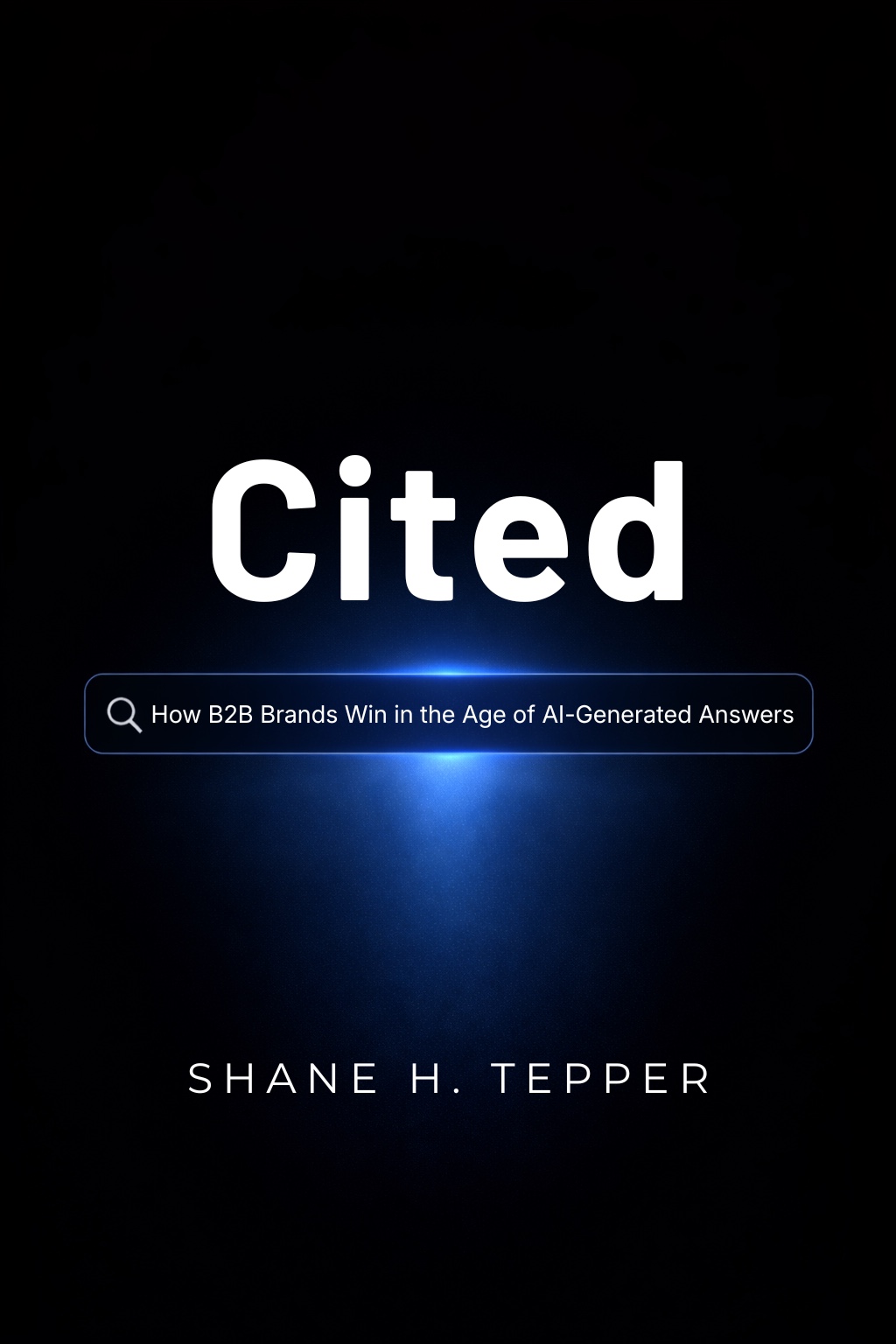
Cited: How B2B Brands Win in the Age of AI-Generated Answers
The first practitioner-grade book on GEO. The methodology, written down.
Get it on Amazon →The team

Kolin Simon
Co-founder, Resonate Labs
Lawyer, engineer, and operator. Runs a B2B GTM SaaS agency in parallel.
LinkedIn →
Shane H. Tepper
Co-founder, Resonate Labs
Writer, strategist, and methodology architect. Author of Cited.
LinkedIn →$997. One price, both halves.
The Foundation and your 150 questions are free, before any of this. The $997 covers the analysis of your sales calls, one crawl on the questions your calls produced, and the report with its ranked action plan. Your card is saved when you order and charged when the report is delivered.
| Your Foundation, and your 150 buyer questions | Free, before any of this |
|---|---|
| Voice of Customer analysis of your sales calls | In the $997 |
| One AI Visibility Crawl on the questions your calls produced | In the $997 |
| The Visibility Report and the ranked action plan | In the $997 |
Step 1
$0
Start your Foundation
your market map, built and revised until you approve it
Free · no card required
Step 2
Due today: $0
Share your calls and authorize
save your card and drop your transcripts in your account. We sharpen the questions, then the crawl runs
Nothing charged yet
Step 3
One charge, $997
Payment on delivery
the charge and the report arrive together
Verify the data the minute you pay
100% Data Integrity & Satisfaction Guarantee
If we can't deliver your report, you're never charged: no deposit, no hold, no invoice chasing you. The charge and the report arrive together, so the first thing your money buys is data you can check.
Want every engine answer word for word? The Answers is the companion document, on the pricing page. Running this every cycle or across brands? Repeat crawls and prepaid packs are there too.
Frequently asked questions
Why do you build the Foundation before I pay?
Because nothing can be measured until you confirm the map. Before we run 150 buyer questions against four AI engines, the picture of who is asking and who you compete with has to be one you stand behind. It is also built from public evidence, which makes it a careful guess about your buyers, and we would rather say so than let you find it. The paid half exists to check it.
Why do you need my sales calls?
The Foundation is an inference about your buyers. Your calls are a record of them. We run the recordings against the map one call at a time, keep every snippet with its speaker role, call, and date, and count which rows your buyers confirmed, which none ever echoed, and which themes the map never had. The questions we then measure are written from that, which is the part nobody else in this category does.
Transcripts or summaries?
Transcripts. Most call tools will hand you a summary, which is a model's account of the call. The transcript is your buyer's own words, and the words are the part we can put in front of the engines. Export from Fathom, Gong, Gemini, Granola, Fireflies, Zoom, or anything that writes a transcript to a file, and drop them in your account. We take .txt, .vtt, .md, .csv, .json, and .docx.
How many calls do you need?
Whatever you have. Sorting the useful calls from the rest is our job: the pipeline triages every call before it extracts anything, drops the ones where you are not the offering under evaluation, and only counts customer and prospect voice toward a theme. A messy archive is the normal input.
What if we do not record sales calls?
The crawl still runs, on the questions written from the Foundation you approved, and the report says plainly which rows are public evidence only. Start recording now: anything recorded before the next cycle is read into the next Foundation, and the questions move toward what your buyers actually raise.
What does it cost, and when am I charged?
The Foundation and your questions are $0, no card required. The Voice of Customer analysis, one crawl, and the report are $997 together: your card is saved when you order and charged only when the report is delivered. The Answers, the companion with every question, every engine answer, and every source cited, and prepaid packs for repeat crawls, are on the pricing page.
How long does it take?
Your Foundation is in your account within one business day. The calls analysis runs next, and its clock depends on the size of your archive. Once your questions lock, allow up to 72 hours for the crawl: we run it during business hours, and a person validates every answer before it reaches you.
Do I have to buy anything after the free Foundation?
No. The Foundation and the questions are yours to keep, correct, and use. The $997 exists for when you want the map checked against your buyers and measured.
No card required
See the map AI is working from. Then correct it in your buyers' own words.
Your Foundation is in your account within one business day, no card required, and revised with you until you would stand behind it. When it is right, share your calls and we sharpen the questions before we measure a thing.
Questions first? Send us a note.
We got it. We'll be in touch shortly.