Forward-deployed GEO engineering
You have the plan.
We help you run it.
Your AI Visibility Crawl tells you what to build. A forward-deployed engineer builds our GEO execution system into your stack, tuned to how you work, and trains your team to run it, so you own it and ship the work yourselves. Built for in-house teams and agencies.
Free 30-minute call. A working conversation, not a pitch. Just need the diagnosis first? Start with the self-serve Visibility Crawl.
95%
of winning vendors
were on the buyer's shortlist before sales got involved
6sense, B2B Buyer Experience Report 2025
Resonate Labs makes B2B teams able to execute GEO, not dependent on us to do it. The self-serve Visibility Crawl scores your visibility across ChatGPT, Claude, Gemini, and Perplexity and hands you a report and action plan. A forward-deployed engineer then builds our execution system into your workflow and trains your team to run it, so the plan ships.
A plan only moves your numbers if someone ships it.
A Visibility Crawl tells you exactly which pages to build and which fixes to make. But visibility climbs only when that work ships, and shipping is where most teams stall. The plan is rarely the hard part. Running it is, and building the capability to run it is harder still.
01
A plan isn't a shipped page.
A visibility score and an action plan don't move AI answers until the work is live.
02
Your team is already at capacity.
GEO competes with everything else on the roadmap, so it slips.
03
Your workflow isn't built for GEO.
Shipping cited pages means new page types, schema, and indexing steps your stack doesn't have yet.
04
Building the tooling from scratch is slow.
Standing up your own skills, templates, and engine takes months. Staffing GEO costs six figures.
The engagement
We build GEO execution into your workflow, and train your team to run it.
A forward-deployed engineer embeds with your team the way a new hire would. They learn how you already create and ship content, then build our AI-enabled GEO execution system into your own stack: our skills library, templates, and execution engine, wired into your repository and tuned to your workflow. Then they train your team to run it. You are left owning and operating the system, so GEO execution lives with the people who own your content, not with us. For how this model compares to a retainer or a DIY tracker, see done-with-you GEO.
How the engagement works
-
01
Embed and learn
The engineer maps how your team creates and ships content today, and where GEO has to fit.
-
02
Build
They stand up our skills library, templates, and execution engine in your own repository, tuned to your workflow.
-
03
Train and hand off
Your team learns to run the system, so it runs the way you already work.
-
04
Prove
A re-crawl shows the plan shipped and your visibility climbed.
What we install
Measurement loop
The loop that turns each Visibility Crawl into tracked progress.
The Visibility Crawl stays the product you commission each cycle. We build in the loop around it, so its findings become shipped work and the movement gets tracked, month over month.
- Built around your 150-query Visibility Crawl
- Scored on the four metrics we measure GEO by
- Month-over-month tracking per brand
- A 30-day prioritized action plan you work from
Execution engine
The reusable toolkit that turns crawl findings into shipped pages.
Each cycle, visibility gaps become new pages, updates, and technical fixes built to be cited. Your team runs the same engine we use ourselves.
- Page archetypes for clean extraction across all four engines
- Deployment SOP for shipping into live sites
- Indexing playbook for AI-crawler access
- Technical readiness checklist for crawlability and indexing
- Prioritization logic for what to ship first
Skills library + training
How your people learn the engine and stay current.
The skills library and templates we use internally, taught to your team. Methodology updates land with you the same week we ship them.
- Onboarding workshop on the Resonate method
- Live working sessions scoped to your engagement
- A private Slack channel for questions and methodology drops
- Release notes when the engines or methodology shift
Foundation Review
A knowledge graph per brand.
The structured market model the AI engines recognize. Every query the crawl runs comes from here.
- Knowledge graph build at engagement start
- Category, ICP, wedge, and competitor mapping
- Buyer-intent query set generation
- Quarterly refresh to stay aligned with the market
The loop your team runs
Running GEO for clients? The same engagement builds our GEO execution system into your agency's delivery workflow and trains your team to run GEO across your client book. Prefer to resell the self-serve Visibility Crawl as a measurable deliverable without building the system in? That is the agency product: see GEO for Agencies.
This isn't a pitch. The loop moves the numbers.
We don't take your content in-house and run it for you. We build the system that lets your team run it, and we prove it works by running the same loop on our own brand. Here it is across three crawl cycles in about six weeks, the loop we install with every engagement.
The work is concrete. The crawl surfaces the buyer questions you're invisible for. Your team builds and ships the pages that answer them, comparison pages, use-case pages, category explainers, on the system we install. The next crawl shows them indexed and cited, with visibility climbing behind them. That is what the engagement leaves you with: a team that ships, measured cycle over cycle, not a slide deck.
Same loop, client edition. Insynctive went 12x more visible in six weeks: 38 pages shipped, +504% ChatGPT bot traffic, every win traced to a specific shipped page.
Proven on our own brand, and our clients'.
 Resonate Labs
 Insynctive
 NeuroguardPlus
 Spectrum Roadmap
The advantage compounds.
Getting into the answer starts two loops. Both keep paying back long after the first crawl.
Visibility → demand
Visibility turns into pipeline.
Showing up where buyers decide feeds the whole funnel: more clicks and impressions on the pages you ship, more inbound requests from buyers who found you in the answer, and the recognition of being the brand the engines keep naming. Every gap you close is demand you were leaving on the table.
Data → platform
Your buyer data becomes a platform.
Every crawl captures the exact questions your buyers ask, who's winning them, and what gets cited. That intelligence fixes visibility, and it powers your other AI workflows: outreach engines that speak your buyers' language, brand content and messaging grounded in real buyer questions, and whatever you build next. The more you run, the more your team compounds.
Built by practitioners running this every day.
We built our methodology in-house, and we refine it as the engines evolve.
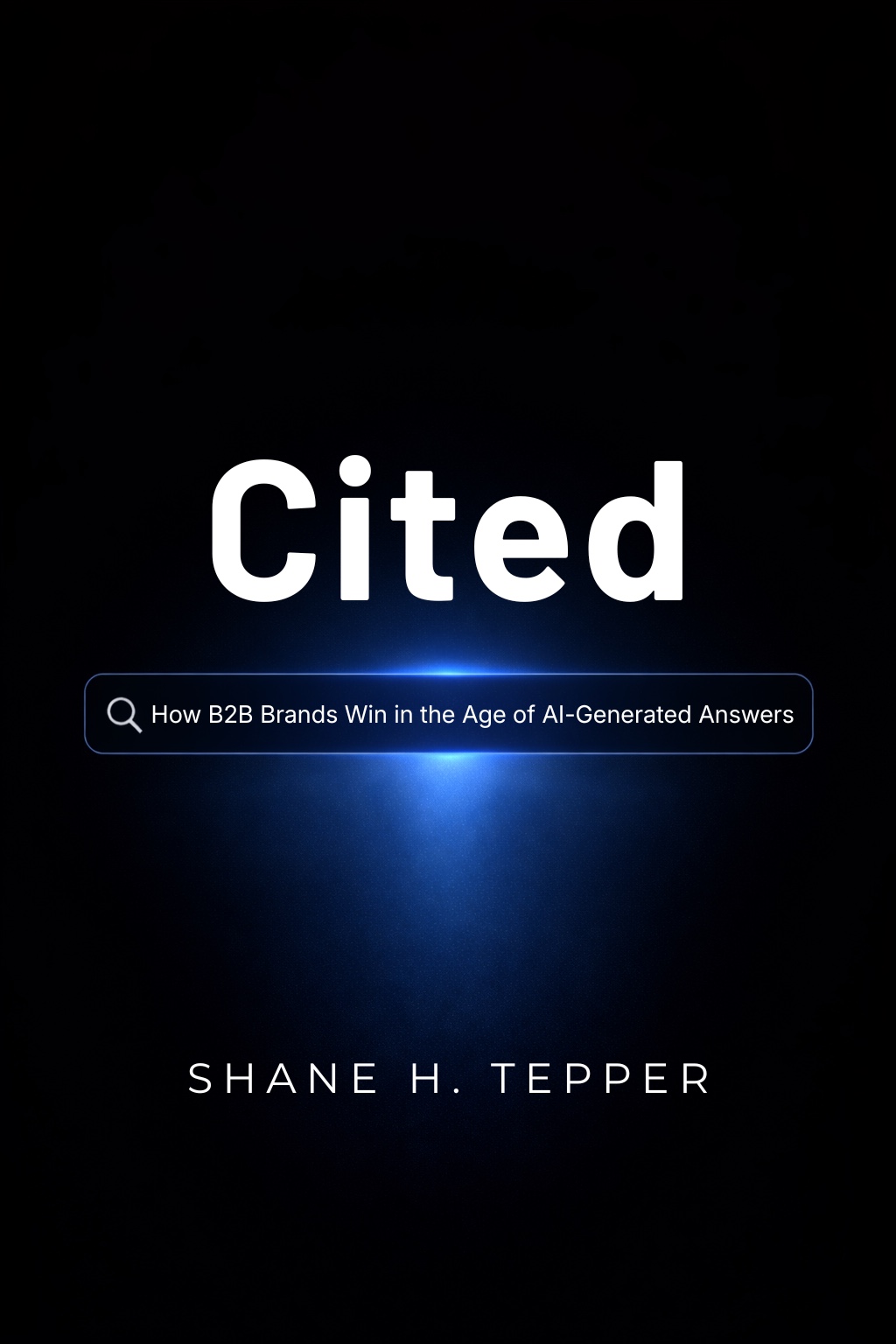
Methodology, published
Cited: How B2B Brands Win in the Age of AI-Generated Answers
The first practitioner-grade book on GEO. The methodology, written down.
Get it on Amazon →The team

Kolin Simon
Co-founder, Resonate Labs
Lawyer, engineer, and operator. Runs a B2B GTM SaaS agency in parallel.
LinkedIn →
Shane H. Tepper
Co-founder, Resonate Labs
Writer, strategist, and methodology architect. Author of Cited.
LinkedIn →Frequently asked questions
What in-house teams and agencies ask most often before an engagement.
The engagement
What does working with Resonate Labs involve?
We embed a forward-deployed engineer who learns your content workflow, builds our AI-enabled GEO execution system into your own stack, and trains your team to run it. Your team is left owning and operating the system, so the action plan ships and keeps shipping. The self-serve Visibility Crawl delivers the visibility report and action plan; this engagement is the hands-on way to execute on it.
What is a forward-deployed GEO engineer?
An engineer who works alongside your team the way a member of it would. They map how you already create and ship content, then build Resonate's skills library, templates, and execution engine into your own git repository, tuned to your workflow, and train your team to run GEO execution natively. You get a bespoke setup on proven components, not generic advice and not a tool to figure out alone.
Do we need to be technical, or already use git?
No. The engineer sets up the workflow with your team, in your own stack, and trains your people to run it, so you do not need an engineering background to start. The system is built to be learned: if your team can create and publish content today, they can run GEO execution on it after the engagement.
Who owns the system after the engagement?
You do. It lives in your own repository and runs on your stack, owned and operated by your team. We build it in and train your people; we do not hold it back or make you dependent on us to run it.
Execution and agencies
Do you write and ship our content for us?
We can, but it is not how we usually work. We get better, more durable results by building the execution system into your workflow and training your team to run it, so the capability stays with you instead of depending on us. If a full done-for-you engagement is what you need, we will scope it on a call.
How does this work for an agency?
The same engagement builds Resonate's GEO execution system into your agency's delivery workflow and trains your team to run GEO across your client book. If you would rather resell the self-serve Visibility Crawl as a measurable deliverable without building the system in, that is the agency product, and GEO for Agencies covers it.
Practical
How is it priced?
Every engagement is custom and scoped on a call. Because an embedded engineer is bespoke to your workflow, stack, and goals, cost and timeline depend on scope, so we size it together rather than list a fixed price. The self-serve Visibility Crawl, which delivers the visibility report and action plan, has fixed pricing on the pricing page.
What happens on the call?
A free 30-minute conversation. We map your goals and your current workflow, figure out what the engagement would build and teach, and scope it. You get a written recommendation by email, including 'this isn't the right time' if that's what we conclude.
Next step
Start a conversation
The fastest way to scope an engagement is a 30-minute call. We map your goals and your current workflow, figure out what the engineer would build and teach, and scope it, whether you're an in-house team or an agency.
- What the engagement would build into your workflow
- What your team would own and run afterward
- How fast the action plan starts shipping